


According to data from the Civil Aviation Authority of Vietnam (CAAV), in the first 11 months of 2025, the total air transport market reached 69.3 million passengers and 1.2 million tonnes of cargo, up 10.8% and 18.5% year-on-year, respectively.
Domestic passenger transport accounted for 30.9 million travelers, an increase of 7.4%, while international services handled 38.4 million passengers, marking a sharp rise of 13.6%.
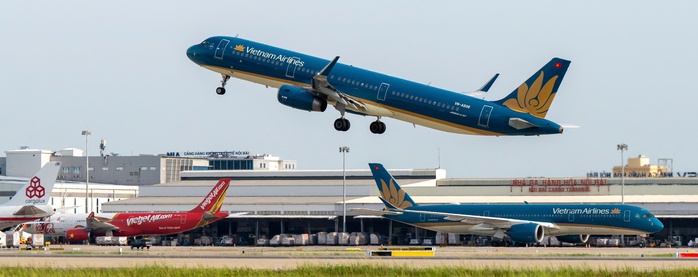
Flight operations at Noi Bai International Airport were bustling in 2025. Photo: Phan Công
Impressive growth
The CAAV expects that by the end of 2025, the sector will handle around 84 million passengers and 1.4 million tonnes of cargo, representing year-on-year increases of 11.4% and 18%, respectively.
"The surging demand for air travel, coupled with the effective implementation of international cooperation in flight operations, has created favorable conditions for airlines to recover and expand," said Director General of CAAV Uong Viet Dung.
The aviation sector is forecast to maintain its recovery momentum and accelerate further in 2026, supported by multiple new growth drivers. The CAAV aims to serve 95 million passengers and 1.6 million tonnes of cargo next year, up 13% and 15%, respectively, compared with 2025.
The primary growth engine will come from the macroeconomic landscape. The GDP growth target of 10% or higher for 2026, recently approved by the National Assembly, is expected to deliver a significant boost to consumption and tourism — two sectors closely tied to aviation.
In addition, the rollout of the revised Civil Aviation Law, along with supportive policies and regulations, will provide a more streamlined legal framework for transport operations. Strategic infrastructure projects — including the first phase of Long Thanh International Airport, as well as the accelerated development of Gia Binh and Phu Quoc airports — are also expected to enhance the industry’s overall operating capacity.
Policies and infrastructure investment needed for long-term growth
The CAAV noted that to achieve these targets, existing bottlenecks in infrastructure and policy mechanisms must be addressed promptly.
It recommended that the Ministry of Construction and other competent authorities consider investing in the expansion of key international airports to prevent prolonged congestion, which raises logistics costs and hampers growth.
It also proposed preferential policies on taxes, fees, and credit interest rates to support the restructuring of aviation enterprises, enabling carriers to strengthen their financial capacity and pursue sustainable recovery and development.
On the market side, further expanding visa and residency policies, along with developing national strategies to attract tourism, will be crucial to increasing international arrivals — a segment that plays a pivotal role in the sector’s overall recovery.
Alongside these expectations, the CAAV also flagged several risks that could impact operations, including armed conflicts, fuel price volatility, and fluctuations in exchange rates and global interest rates.
Geopolitical developments and global trade dynamics will remain key variables that require close monitoring throughout policy planning and adjustment.



 và quét mã QR
Bạn không thể gửi bình luận liên tục. Xin hãy đợi
60 giây nữa.